The essential distinction
Three numbers. Not one verdict.
The debate over data-center development combines questions about local control, electricity costs, union jobs and political influence. The records below illuminate different parts of that debate. They do not, on their own, explain why any particular senator voted yes.
What people said
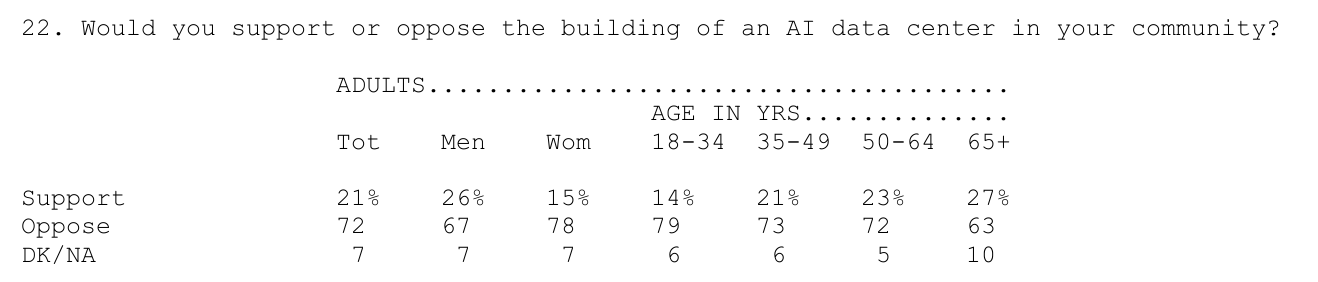
An AI data center in your community?
Quinnipiac University poll · 1,202 U.S. adults nationwide, Sept. 24–27, 2026. Not a poll on the bill.
What the Senate voted on
End debate on the amendment?
Yes 70
49 R · 20 D · 1 I
No 27
2 R · 24 D · 1 I
One dot per senator who voted. Not voting: 2 R, 1 D. Roll call 264 · Nov. 16, 2026. Not final passage.
What the coalition reported
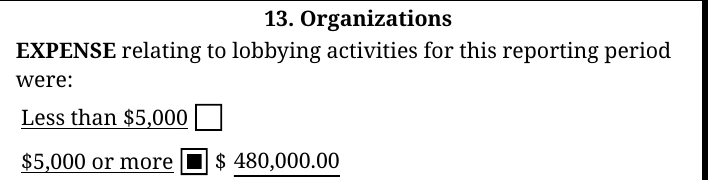
$480,000 in quarterly lobbying
The Data Center Coalition reported this total for all its federal lobbying in Q3 2026, not spending on this bill alone.
Original LD-2 filing · Cropped to show the expense line.
What did the public actually answer?
Quinnipiac University surveyed 1,202 U.S. adults nationwide from September 24 to 27, 2026. Asked about an AI data center in their own community, 72% opposed it, 21% supported it and 7% gave no opinion. The poll had a margin of error of ±3.5 percentage points. It measured views on a hypothetical nearby project, not on a specific site or on the Bipartisan American Affordability and Jobs Act, or BAAJA.
That distinction does not make public concern irrelevant. It tells us the question policymakers still have to address: how are local concerns being weighed in a national permitting deal?
What did the Senate actually do?
The November 16 roll call records a 70–27 vote on cloture for the substitute amendment. Cloture limits debate and moves consideration forward. It is not the same as voting to pass the bill.
On November 18, the Senate adopted the substitute amendment, 69–27, then voted 65–31 to limit debate on the amended bill. Neither vote was final passage.
This is a snapshot of what the Senate had done through November 18, not a claim that the bill became law.
Voters and their representatives
Voters were wary. The Senate moved ahead.
Quinnipiac’s registered-voter results put that tension in sharper focus. Of 1,032 self-identified registered voters surveyed nationwide September 24 to 27, 2026, 73% opposed an AI data center in their community and 21% supported one. On November 16, 70 senators voted to end debate on the permitting amendment and 27 voted against ending debate.
Pennsylvania puts names to the vote
In a July 2026 Quinnipiac poll of 895 Pennsylvania registered voters, 74% opposed a nearby AI data center and 16% supported one. Both of the state’s senators, Democrat John Fetterman and Republican Dave McCormick, voted yes on the November 16 procedural motion.
Those are different questions. The polls did not ask voters whether they supported this bill, and the Senate did not vote to approve a specific data center. Still, both Pennsylvania senators helped advance a deal that changes how projects are reviewed. They should explain what weight they gave to the concerns voters expressed about projects close to home.
What does the money establish?
The Data Center Coalition’s third-quarter federal lobbying disclosure reports $480,000 in total expenses and names BAAJA among multiple issues. The amount covers the reporting period’s lobbying work, not a separately priced campaign for this bill.
The filing lists government bodies contacted. It does not identify individual senators, disclose what each meeting covered, or establish a connection between a particular request and a particular vote. Lobbying expenses are also different from campaign contributions.
Why the trade-offs deserve scrutiny
IBEW makes the case that permitting reform can advance energy infrastructure and employment. The bill’s authors also point to protections intended to keep certain new data-center grid costs from being shifted to other customers. The substitute’s Section 2107 would require utilities to recover certain incremental costs of serving qualifying new data centers from those customers. Supporters argue that this protects other ratepayers. Whether it would do so in practice depends on how those costs are measured and recovered.
NCAI warns that the substitute leaves threats to Tribal sovereignty, sacred places and judicial remedies unresolved. For example, Section 1134 would shorten the window for certain court challenges involving projects covered by the federal FAST-41 permitting process from two years to 150 days. That is a specific change to how some permits can be challenged, not blanket approval for data centers. The relevant question is not simply whether a process is faster, but what safeguards remain.
Read the authors’ release and linked substitute text alongside the union and Tribal statements in the source ledger. The bill language and the advocacy for or against it are different kinds of evidence.
Who did you meet with, what did they ask for, and what changed in the bill because of it?
That is our editorial demand for transparency. It is not an allegation that a contribution bought a vote. The documents cited here do not establish that.